From its vibrant capital city in the North to its desert expanse in the South, Jordan has lots to offer. Despite its rather small size Jordan is a treasure trove of experiences and, if you don’t want to, you don’t have to stick to the classics that are overrun by tourists already.
From a Wonder of the World to hidden gems, these are the best sites in Jordan
In this article, we will introduce you to the best sites in Jordan from its most popular sites such as Petra and Wadi Rum to lesser known hidden gems such as Amman’s local street food stalls and wide array of nature reserves in the center and south of the country.
Key Takeaways
Jordan offers rich history, iconic sites like Petra and the Dead Sea, and stunning deserts such as Wadi Rum.
Explore ancient ruins, natural wonders, and vibrant culture in Amman and beyond.
Must-see spots in Jordan include Petra, Wadi Rum, Ajloun Castle, and Mount Nebo.
Book a Wadi Rum Jeep Tour with Wadi Tribe for an unforgettable al-inclusive desert adventure without worries.
A Traveler’s Introduction to Jordan
Welcome to Jordan, a small country packed with culture and incredibly sites.
Jordan is a small country in the Middle East known for its rich history and stunning landscapes. It is home to over 10 million people and offers visitors a mix of ancient ruins, deserts, and natural wonders.
Famous sights include the ancient city of Petra, a UNESCO World Heritage Site carved into rose-colored sandstone cliffs, and the Dead Sea, the lowest point on Earth’s surface where you can float effortlessly in mineral-rich waters. Jordan also features vast deserts and valleys like Wadi Mujib and Wadi Rum with towering cliffs and unique rock formations.
With friendly locals, vibrant culture, and safe travel conditions, Jordan is a must-visit destination for anyone wanting to explore history and nature in one trip. Most Western tourists enter easily with a visa on arrival, the local language is Arabic with many English speakers and the local currency is the Jordanian Dinar (JOD).
5 Things to Do Before You Arrive in Jordan
Don’t carry hard, carry smart. This is to do and pack before coming to Jordan.
When planning a trip to Jordan, there are a few things you should do before you take your flight to Amman (or Aqaba). Doing the following five things will not only make your trip a lot more enjoyable, but also help you save a lot of money and respect local culture:
Buy the Jordan Pass: If you haven’t heard about it before, the Jordan Pass is a tourist pass that covers your entry visa fee and entrance fees to many of the best sites in Jordan such as Petra and Wadi Rum – and it’s absolutely worth it. For the sceptics among you, check out our full price breakdown of the Jordan Pass.
Pack the Right Things: When visiting Jordan during high season in spring or fall, make sure to pack for the heat and the cold. While days tend to be very sunny and hot and require you to wear loose clothing and sunscreen, nights can be surprisingly cold, requiring you to bring at least one extra layer and a hat.
Learn about Jordanian Culture: Jordanians are very hospitable and used to introduction tourists to their culture. Nonetheless, we believe that it is our duty to learn at least some things about a new country before w arrive to it. Watch a 10-minute YouTube video about Jordan and Jordanian culture or read up on our 10 best Jordan travel tips.
Check Your Documents: Note that, to enter Jordan on a tourist visa, you need a valid passport that is valid for at least another six months. Additionally, we recommend bringing along your International Driver’s License, if you plan to rent a car and to make sure to have an international travel insurance.
Consider Booking a Jordan Tour: While you can easily explore Jordan on your own, there are some places we recommend booking a tour for. The Wadi Rum desert in Southern Jordan is one of those places to visit on a tour. In Wadi Rum, individual sites are very far from each other, requiring you to have a guide with a jeep to take you there.
The 16+ Best Places to Visit in Jordan
From Jordan’s capital city Amman to the Lost City of Petra and the Wadi Rum desert in the south, there is a lot of must-see places in Jordan. Even better, many more sites in Jordan are still not on the radar of the average tourist.
So, these are 16+ of the best places to visit in Jordan from world-famous UNESCO World Heritage Sites to hidden gems in the Jordanian desert:
The Lost City of Petra
A bird’s eye view of the famous treasury of Petra.
Ever since being named one of the New Seven Wonders of the World in 2007, the Lost City of Petra has steadily gained the world’s attention and attracted more than one million annual tourists as recently as 2026. The UNESCO World Heritage Site consists of a vast complex of dwellings, tombs, theatres and places of worship that were cut into the local rose sandstone rock. This also earned the city the title of the ‘Rose City’
The Rose City of Petra was first established by the Nabataeans, an ancient North Arabian tribe of Bedouins, in the 4th century BC. Under the Nabataeans, the city of Petra came to flourish as a center of local trade and grew extensively, adding most of its modern sights to its cityscape. Later, Petra came under Roman influence and received considerable attention from its new rulers. During this time, more important sights such as the Roman theatre and more tombs followed.
By the end of antiquity, Petra started a period of rapid demise, that would see the city be abandoned almost completely at times. Throughout most of the Middle Ages and Modernity, the only inhabitants of Petra were small number of local Bedouin. To Western audiences, Petra would only become tangible by the 19th century, when the Swiss explorer Burckhardt was shown the way to the city by the Bedouin.
Today, you can visit the Petra Archaeological Site for free using the Jordan Pass. To explore the full archaeological site, we recommend setting aside a full day or two. For your overnight stay, you can find accommodation in the nearby modern town of Wadi Musa.
The Wadi Rum Desert
The desert expanse of the Wadi Rum Protected Area.
After you visit Petra, we recommend you to venture further south to explore the Wadi Rum desert. In the shadow of the World Wonder of Petra, Wadi Rum has steadily developed into one of Jordan’s best sites welcoming up to 200,000 visitors annually in recent years.
The Wadi Rum desert, a UNESCO World Heritage Site since 2011, is a vast desert in Southern Jordan that is characterised by red sand and heavily eroded sandstone rock formations. Moreover, it is defined by the seasonal flow of water that makes the desert extremely dry in summer, but provides vital water to local flora and fauna in winter.
In spite of the harsh conditions in the Wadi Rum desert, the , a collection of nomadic Arabian tribes, have called it their home for centuries now. The Bedouin, such as the Al-Zalabiah tribe, followed in the footsteps of the Nabataeans, the same people that built Petra, and continue to define the face of the Wadi Rum desert today, though their freedom of movement is heavily restricted now.
In more recent times, Wadi Rum has gained international fame for its role as a set in several Hollywood movies. The first major movie set in Wadi Rum was the story of . Some more recent blockbuster productions partly set in Wadi Rum are Dune, and John Wick 4.
When visiting Wadi Rum, we recommend booking a full jeep tour package including a stay in a Bedouin camp and meals to make the most of your money and time in the desert. If you come to Wadi Rum with a Jordan Pass, your entry to the Wadi Rum Protected Area will be free.
Ajloun Castle, a Defense Against Crusaders
The medieval castle of Ajloun, a defence against Christian crusaders.
In the Middle Ages, the face of the Middle East was dominated by the chaos that the so-called crusades brought along with them. The crusades, a war waged by European Christians against local Muslim rulers to take back to Holy Land (Palestine), left many marks in Jordan, among them the Crusaders’ Castle of Ajloun.
Ajloun Castle in the North of Jordan was built in the 12th century by local Muslim rulers as a defence against Christian crusaders. The castle was built in a strategic position overlooking the Jordan Valley and three wadis descending into it. After the crusades, Ajloun Castle continued to play a rule in the defence against Mongol attackers and later as an Ottoman lookout.
For your visit to Ajloun Castle, we recommend planning a day trip from Jordan’s capital city Amman, either by rental car or by JETT bus. The entrance fee to Ajloun Castle is included in the Jordan Pass.
The Ancient City of Jerash
The remnants of the ancient city of Jerash
Combine your day trip to Ajloun Castle with a stop in the ancient Roman city of Jerash. Internationally, the city of Jerash is known for housing some of the best-preserved Greco-Roman ruins in the world, earning it the nickname of ‘The Pompeii of the East’.
During the Greco-Roman period the city of Gerasa, as it was known then, flourished and added many of the ruins that attract hundreds of thousands of visitors today, such as the Arch of Hadrian and two Greco-Roman theatres. After suffering from the effects of several earthquakes, Gerasa was completely destroyed by Christian crusaders in the 12th century. Today, Jerash is once again a local population center and a huge pull for international visitors.
To visit Jerash, we recommend planning a day trip from Amman including both Jerash and Ajloun Castle. For this day trip, you can either rent a car or use a mix of buses and taxis. The entrance to the ancient ruins of Jerash is included in the Jordan Pass.
The Amman Citadel
The Amman Citadel, a site that tells the stories of several millennia.
To find interesting places in Jordan, one doesn’t have to stray far from its capital city. In fact, Amman houses some of the most important historical sites of the whole country from all eras. One of those, the Amman Citadel, tells the history of Amman throughout several millennia, featuring an ancient temple, a Byzantine church and an Umayyad palace.
The Amman Citadel, a collection of archaeological sites on a hill, is located with walking distance from Amman’s modern city center and can be combined easily with other historic sites of the city such as the Roman theatre of Amman.
For your visit to the Amman Citadel we recommend to set aside half a day. For the best experience, we also recommend arriving early to beat the masses and the midday heat. After exploring the Amman Citadel and the Roman theatre, which are both included in the Jordan Pass, you can head into Downtown Amman to get lunch and continue your day.
Downtown Amman & Its Iconic Food Spots
Dive into Jordanian street food culture in Downtown Amman.
Talking about Downtown Amman, the city centre of Jordan’s capital city is your perfect chance to not only get familiar with the country’s history, but also its food culture. Dotted all throughout Downtown Amman, you can find several iconic food spots, from stands on the local food market and an endless selection of shawarma shops to Hashem’s Restaurants serving up fresh falafel and other Jordanian staples to hungry Jordanians or an endless selection of shawarma shops.
Once you have devoured some of the world’s most delicious food, Downtown Amman – and hopefully your stomach – even has some space left for a delectable dessert. For any first-time visitor to Amman there is no way around trying the iconic Kunafah by Habibah’s Sweets that came to Amman straight from Nablus, Palestine. The Nabulsi Kunafah is a local favourite and the perfect way to end your lunch break in the Downtown era.
If your are not sure yet where to stay in Amman, we recommend staying in the Downtown area. This area not only offers accommodation options at any price points, but also puts you within walking distance of several sights such as the Amman Citadel and the Roman theater of Amman. Our choice of stay in Amman, The Bunk Hostel, provides a nice balance of affordability and convenience.
Rainbow Street & Modern Amman
Can you guess where Rainbow Street got its name from?
After talking so much about Jordan’s ancient and medieval history, it is tempting to forget that Jordan is not just one big archaeological site, but a real country that keeps developing. One such site of development is Rainbow Street.
Rainbow Street is a street and area located on one of Amman’s many hills. The street is seen as a cultural center of Modern Amman and a great place for young people to go out. All along Rainbow Street, you can find local stores, restaurants and cafés, each providing a noticeable contrast from the busy and more traditional streets of Downtown Amman.
Some of businesses worth visiting along Rainbow Street are The Good Bookshop, a mix of café and bookstore, Authentage, a huge vintage store, and its many souvenir stores that not only give you an excuse to shop, but also teach you more about Jordan’s modern history and its connection to the historically Palestinian territories. Nearby Rainbow Street you will also find the Jordan Museum where you can continue learning about the country’s more recent history.
While Rainbow Street is within walking distance of the Downtown area, we do want to warn you of the rather steep walk there. If you are not an avid uphill walker, we recommend getting an Uber or Kareem up Jabal Amman and to get back to your hotel by foot. A visit to Rainbow Street is the perfect pick for a laid-back afternoon and some souvenir shopping.
Mount Nebo
A memorial of Mount Nebo’s biblical importance.
Venturing south from Amman, the first notable site you will pass it Mount Neto. Mount Nebo, not to be confused with its namesake in Utah, is a fairly short mountain standing tall – or short – at just 700 meters (or 2,300 feet). While not impressive in height, Mount Nero is all the more impressive in religious importance.
Mount Nebo is considered a holy site for Christians, due to its role in the Bible. In the Bible, Mount Nebo is the place where Moses saw the Promised Land (Canaan) before he passed away on this very mountain. To this day, Mount Nebo is heavily frequented by pilgrims wishing to have the same panoramic view of the Jordan Valley and the West Bank from the summit.
If you are planning to hike Mount Nebo, we recommend visiting it either as a day trip from Amman or as a stop on your way to the Dead Sea. The summit hike of Mount Nebo is fairly beginner-friendly and takes little more one hour, even if you take the more scenic Siyagha Loop.
The Dead Sea of Jordan
The shoreline of one of the world’s saltiest lakes.
There is no shortage of incredible natural sights in Jordan. After the Wadi Rum desert, the Dead Sea of Jordan is yet another unique phenomenon that is rarely found in other parts of the world. The Dead Sea, a highly saline lake bordering Jordan, Palestine and Israel, is a natural phenomenon caused by a combination of high evaporation and low supply of new water from the Jordan River.
The Dead Sea is considered one of the saltiest lakes of the world and doesn’t allow for any marine life to prosper in its water – hence the name ‘Dead Sea’. Fittingly, the Dead Sea is also referred to as the Lake of Sodom. While it is not attractive to marine life, the Dead Sea is all the more attractive to tourists, that not only flock to the lake to float on its saline surface, but also use the Dead Sea mud for supposedly healthy skin treatments.
If you are planning to visit the Dead Sea, your best bet is booking a day pass at one of the Dead Sea resorts. A day pass not only gives you access to the hotel’s private beach, but also lets you use their pool and shower facilities and often come switch discounts or credits for their restaurants and bars. Alternatively, you can also visit a free public beach.
Find out more about visiting the Dead Sea and why you should bring plenty of bottled water to its public beaches in our
Ma’in Hot Springs
Kick back and relax for a day at the Ma’in Hot Springs.
Only in Jordan you can go from cold salty water to hot thermal water within minutes, at least if you add to Ma’in Hot Springs to your itinerary after your visit to the Dead Sea. The Ma’in Hot Springs are a collection of hot minerals springs located between the Dead Sea and the city of Madaba. With temperatures of up to 60 °C (140 °F), the Ma’in Hot Springs are a major destination for medical and wellness tourists looking for pain and muscle relief.
At Ma’in Hot Springs you can only find very few hotels. Therefore, your visit to the Ma’in Hot Springs is best done as a day trip from the Dead Sea or Madaba or as a stop on your road trip to Southern Jordan. Staying overnight in a Dead Sea Resort will get you closer to the hot springs, while Madaba offers cheaper accommodation options.
For your visit to the Ma’in Hot Springs, we recommend setting aside half a day, with the second half of the day left for exploring nearby Madaba. While there are 63 springs in total at Ma’in Hot Springs, many of them have the same composition, meaning that three to four hours in the pools are more than enough for your visit. Also note that the entrance fee to the Ma’in Hot Springs is NOT included in the Jordan Pass.
Wadi Mujib & Its Adventure Hiking Trails
A view of the Dead Sea from the heights of Wadi Mujib.
While Wadi Rum is primarily known for being a dry inhospitable desert, Wadi Mujib is all the opposite. Contrary to what its name suggests, Wadi Mujib actually enjoys a year-round flow of water that it accumulates from seven tributaries before emptying into the Dead Sea.
Wadi Mujib, located in central Jordan between the Karak and Madaba Mountains is of particular interest because of the Mujib Biosphere Reserve. In the reserve, outdoor enthusiasts can, not only, go on hikes, but also do canyoning and zip lining. Most of Wadi Mujib’s hiking trails start somewhere in the vicinity of the Dead Sea Highway and then take you deep into the mountains upstream.
For your hike in Wadi Mujib, we recommend bringing a change of clothing as most hikes include sections of hiking in water or outright swimming. Depending on the hike you choose, you may also be required to hire a guide. The entrance fee to the Mujib Biosphere Reserve is not included in the Jordan Pass.
Karak Castle, a Crusader Stronghold
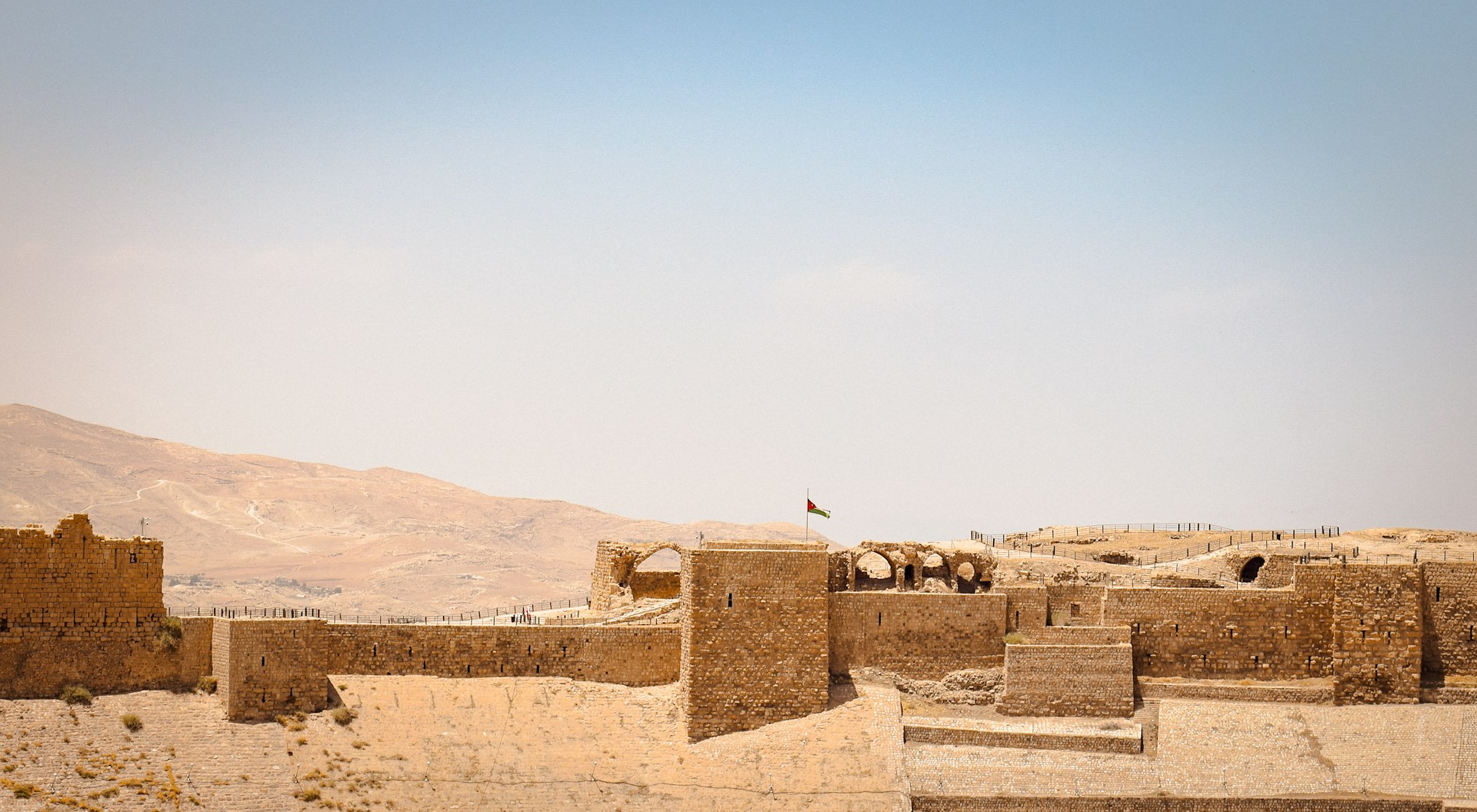
Karak Castle, one of the biggest castles of the Middle East.
After exploring Ajloun Castle in Northern Jordan, a strong defence against Christian crusaders, Karak Castle in Central Jordan is yet another reminder of the crusades in Jordan, but this one was built by the Christian crusaders rather than the local Muslim rulers. Built in the mid-12th century, the crusader castle or Karak, or Kerak, was used to control local trade and withstood several siege attempts by Saladin, only to be taken by his nephew towards the end of the 12th century.
Karak Castle is considered to be one of the largest castles of the Levant and a well-preserved example of Christian crusade architecture. Today, its ruins are largely accessible and draw hundreds of thousands of curious tourists year after year.
If you plan to visit Karak Castle, your best way to get there, is by rental car or public transportation. The castle is conveniently located between the Dead Sea and Petra, making it a great half-day stop on a Jordan road trip. The entrance fee to Karak Castle is already included in the Jordan Pass.
Dana Biosphere Reserve
Away from the masses, into nature: Dana Biosphere Reserve.
There is something about Jordan and unique landscapes. In Wadi Rum, you can see otherworldly rock formations jut out of red sand dunes. In Wadi Mujib, you can traverse narrow canyons while knee-deep in water. And in the Dana Biosphere Reserve you can find yet another natural phenomenon of Jordan.
The Dana Biosphere Reserve is Jordan’s largest nature reserve located in the center of the country. Its landscape, a stark contrast to Wadi Rum and Wadi Mujib, is defined by extensive white sandstone formations that stretch through all of Jordan’s four climate zones, which makes for a diverse landscape for hikers.
Another big plus of the Dana Biosphere Reserve has to be the fact that it’s far less frequented than the tourist hotspots of Jordan. If you are looking for a break from the masses in between visiting Petra and Wadi Rum, the Dana Biosphere Reserve is just the way to go. Located just off the King’s Highway, it is still easily accessible by rental car or taxi.
Little Petra, Petra’s Little Brother
Small, but oho, as the Germans say: Little Petra.
Little Petra is – drum roll – a smaller archaeological site located just a few kilometers away from the main complex of Petra. Its name not only refers to its geographical proximity, but also its looks. Similarly to Petra, Little Petra shows the same features of extensive buildings cut into the mountain surface.
Albeit significantly smaller than Petra, Little Petra is no less impressive than its larger counterpart. Believed to have been built as a wealthier suburb of Petra itself, Little Petra offers equally impressive architecture and archaeological remains. Additionally, Little Petra is also part of the complexes recognised as a UNESCO World Heritage Site.
If you have some more time to spare in Wadi Musa or if you are just not one for big masses of tourists pushing towards the Treasury of Petra, we highly recommend the quieter Little Petra. Little Petra is easily accessible by rental car and taxi or through a hiking trail from the main archaeological site.
The Red Sea of Jordan
Explore the underwater world of Jordan’s Red Sea.
In the South of Jordan, the coastal city of Aqaba marks Jordan’s only sea access. This makes Aqaba not only an important entry port of commerce and ferry tourists, but also a popular diving destination. The Red Sea of Jordan offers a number of reef diving and wreck diving destinations that rival some of the Red Sea dive sites of Egypt.
If you are into scuba diving or free diving, you can’t miss out on some of Jordan’s dive sites such as the Seven Sisters reef dive site and the Cedar Pride wreck dive site. Even for beginners, Aqaba can be a great destinations, with multiple companies offering introductory diving courses with internationally recognised certifications such as PADI.
To dive in the Red Sea, you can either stay in an affordable hotel in Aqaba itself or choose to stay in one of the resort hotels along the coast in Tala Bay just south of Aqaba. Dives at Aqaba’s dive sites can be booking online in advance or onsite at the companies’ main offices in Aqaba. For courses, we recommend booking online in advance.
Curious about diving in the Red Sea? Find out
Jebel Umm Ad Dami, Jordan’s Highest Mountain
Scale the highest mountain of Jordan in Wadi Rum.
As you arrive to the end of the Desert Highway, the Wadi Rum Desert has one more outdoor activity in stock for you. Besides its Jeep Tours and Bedouin Culture, Wadi Rum also has a selection of hikes that are absolutely worth spending a day on. While we also love the hikes to Burdah Rock Bridge and Jebel Al-Hash, we recommend summiting Jebel Umm Ad Dami in Wadi Rum.
Jebel Umm Ad Dami is Jordan’s highest mountain standing tall at 1,854 meters (6,083 feet) blessing hikers with extensive views of the Wadi Rum Desert, other parts of Jordan, Saudi Arabia and, on a good day, views of the West Bank.
To hike Jebel Umm Ad Dami, hikers are required to hire a local Bedouin guides. Hiking trails in Wadi Rum are not marked and very remote. With a Bedouin guide, you will not only have someone to guide you to the summit, but also enjoy meals and Bedouin tea along the way, before spending a night in one of Wadi Rum’s many Bedouin camps.
The Bottom Line
Your Jordan adventure awaits you.
Jordan might be a small country, but it’s far from being a boring one. Packed into a relatively small land area, you can find historic site of countless different eras and natural site you cannot find anywhere else in the world. Add to that a vibrant culture from Amman’s modern city culture to Wadi Rum’s Bedouin culture and you have Jordan. Now that you know the very best sites all around the country, we are sure, you will have a great time in it.
Frequently Asked Questions
What is famous in Jordan for shopping?
When shopping for souvenirs in Jordan, you can look out for regional spices and olive oil, local textiles such as keffiyehs and abayas and skin products made from the iconic Dead Sea mud. A great place for shopping Jordanian goods is the Amman market.
What should you see in Jordan?
When in Jordan, you cannot miss out on experiencing Amman, visiting the Lost City of Petra and exploring the Wadi Rum Desert. For off-the-beaten-path experiences, you can choose some of the lesser known sites in our list.
What not to miss Jordan?
Many tourists coming to Jordan, make the trip down to Petra, but shy away from heading all the way down to Wadi Rum. If you are going to Petra already, we highly recommend you visit Wadi Rum as well. The Wadi Rum desert is a great mix of natural beauty, historical sights and unique, Bedouin culture.
Can I brush my teeth with tap water in Jordan?
Yes, you should be fine using tap water to brush your teeth in Jordan. In Wadi Rum, we even drank tap water for three weeks straight and never had any stomach issues. Still though, we recommend you spit your water out when brushing your teeth (duh).
Some links in this post are affiliate links, which means I may earn a commission if you decide to make a purchase — at no additional cost to you. Thanks for supporting Wadi Tribe!
Latest Posts
Have we awakened your wanderlust? Check out more travel itineraries, transfer guides and cultural lessons from all over the Middle East.
7th July 2026
Since its acceptance of the World Heritage Convention on May 5, 1975, Jordan has accumulated a total of seven UNESCO World Heritage Sites, an impressive number for such a small country. Year after year, the World Heritage Committee sits together to name the newest additions to the World Heritage List, valuing new entries for their…
3rd July 2026
Wrapping up your trip in the Caucasus and looking for travel routes into Turkey now? Getting from Georgia to Turkey is possible by airplane and by bus. Depending on your preference – saving time, saving money, or a mixture of both – there are four travel routes you can take. In this article, we will…
26th June 2026
Are you planning to visit Egypt for the first time? Congratulations! You are in for a fantastic time. Do watch out though, Egypt is not like any other place. To make your first trip to Egypt even more fantastic, we will be sharing what to know before going to Egypt today. In this article, you…
 From a Wonder of the World to hidden gems, these are the best sites in Jordan
 Welcome to Jordan, a small country packed with culture and incredibly sites.
  Don’t carry hard, carry smart. This is to do and pack before coming to Jordan.
 A bird’s eye view of the famous treasury of Petra.
  The desert expanse of the Wadi Rum Protected Area.
 The medieval castle of Ajloun, a defence against Christian crusaders.
  The remnants of the ancient city of Jerash
 The Amman Citadel, a site that tells the stories of several millennia.
 Dive into Jordanian street food culture in Downtown Amman.
 Can you guess where Rainbow Street got its name from?
 A memorial of Mount Nebo’s biblical importance.
 The shoreline of one of the world’s saltiest lakes.
 Kick back and relax for a day at the Ma’in Hot Springs.
  A view of the Dead Sea from the heights of Wadi Mujib.
 Karak Castle, one of the biggest castles of the Middle East.
  Away from the masses, into nature: Dana Biosphere Reserve.
  Small, but oho, as the Germans say: Little Petra.
  Explore the underwater world of Jordan’s Red Sea.
  Scale the highest mountain of Jordan in Wadi Rum.
  Your Jordan adventure awaits you.